

The Terror - A Soundscape Piece
- Jan 18, 2022
- 6 min read
Immersion in sound engineering is an important aspect when painting a scene or telling a story through audio alone, as sound constitutes a massive role in the production of most forms of media; save for traditional art (ie paintings and mosaics), sound is crucial to building an immersive experience for music alone, film, TV, audiobooks, and installations, as well as other forms of media. A prime example of this can be seen in Soundscapes, audible pieces of work that merge recordings of ambience, music, found sounds, and samples to create an intangible landscape that immerses the listener inside it, as thought they were actually there.
This works best in surround sound systems such a 5.1 or 7.2 system setups, however use of headphones for binaural surround sound experiences can work similarly for a more intimate feel rather than a grandiose scale that 5.1 can offer. As a result, I decided to task myself with the creation of a soundscape stuck purely to binaural audio, titled 'The Terror'.
Due to the nature of Covid-19 in December, I was unable to gain access to a studio which had a sufficient surround sound system, and my home studio doesn't have this either. As a result, I was forced to adapt and consider the idea of creating a binaural soundscape through headphones. This worked out massively in my favour as my idea was to have a soundscape tied to the concept of "life being a video game" more commonly known as "simulation theory". This meant I could have sound still appear in 360 degrees around the listener, but have it more intimate within the listener's ears through headphones; this also worked as it gave the impression of the listener wearing a VR headset to further emphasise the themes of the soundscape.
To begin, I travelled to capture some ambience that would be used within the piece in order to create jumps between the two; my idea was that the "simulation" would disrupt and become glitched, causing the settings to change at random, leaving the listener feeling disorientated and unnerved. Soundscapes are often meant to encapsulate settings similar to real-life, and while the "fabricated" settings I was painting within the idea of the "simulation" where more realistic, the simulation aspect was much more harsh and alien, with my desire being to make it feel almost psychological horror-like.
The areas I covered to get these natural ambiences were Hogganfield Loch, the currently under-renovation golf course next to the Loch, Glasgow Central Station, Ayr Town Centre, and UWS Paisley Campus. I recorded ambience in these areas with a Zoom H4n Pro Handy Recorder and an Audio Technica AT875R Shotgun Microphone; the handy recorder allowed me to get a good stereo image of my surroundings, while the shotgun mic excelled in targetting in on sounds I was too far away to reach. I would record 4 times in 4 different directions in order to pan the recordings out later with Ambeo Orbit, to create the 360 degrees plane. Using the AT875R, I also managed to record close-up sounds of birds flying away, river loudly flowing by where I couldn't get close, and even swans eating, making sure not to harass or irritate them to avoid unintential animal abuse most importantly, and also to ensure an effective recording of swans eating.
Other sounds replicating natural sources such as fire, rain, and a television, where created through the use of Omnisphere 2, a synthesiser which houses a variety of sounds and samples that are present in a variety of film, TV, and video-game soundtracks, including Silent Hill 2. Some of these samples include Sedation (used in 'The Trail' for SH2) and Daybreak (used in 'Heaven's Night' and 'Prisonic Fairytale' for SH2), which I both used for the ambient musical piece that plays through out the entire piece. I wanted the music to run throughout the entire track in order to create an unsettling, almost invisible at times tone that crept through slowly as the viewer fled in and out of these various surroundings.

The remaining sounds were replicated sounds attempting to emulate video-game BIOS sounds from the PlayStation and PlayStation 2, the sound of electrical interference or static whenever the setting in the simulation changed, or the sound of an otherworldly demon; all of these were again done through Omnisphere 2 but also through the Roland SRX Keyboards synth that offers a variety of sounds from Roland synths from the 90s.

The very last component of the soundscape was the voice; I wanted to obtain a robotic text-to-speech voice reminiscent of the one found on the Radiohead track 'Fitter Happier'; a website called Tetyys, featured a variety of TTS voices from across the decades, one of which was Microsoft Sam for the Windows XP operating system. The tone of Sam's voice was harsh, slightly garbled, and almost creepy, as its syntax, when sentences were long, was almost monotonuous or repetitive, giving a broken, run-down aspect.
The Tetyys website allows the user to input any length of text for the selected voice to read, which will then render allowing for playback and for downloading. The speech used was taken from the Mayo Clinic page on Sleep Terrors, as this was related to the idea that life is a simulation, however no one is actively conscious of this knowledge. The information was also available on a variety of other websites which I sampled, including the NHS's website, and Healthline. Interspersed with this speech was also lines I added in myself, relating to the idea that if life is a video game, everyone is their own God and their own Satan, that they are in charge of the world, and that everyone else believes themselves to be the exception in the world, but that they themselves are the only true exception.

With the main recording done, I proceeded to bring everything together in Live 10 and ordered the progression of events, starting with a simple scene of a rainy day outdoors by a river near a road before transitioning to a warped train scene, leading into a city scene, into a calm outdoors scene, cutting to silence before the voice constructs settings as it speaks; a train scene with a demon approaching, a park scene where swans are killed by a demon, and a city scene where insects hoard the listener. It lastly cuts to a home, where the demon watches the TV before screaming as the last scene plays in bed; going to sleep on a bed of spikes and flames, the listener achieves 'godliness' (dies), realising they have the ability to control everything, before crying over if anything is even real anymore.

Processing was somewhat sparse as I wanted to keep the original ambient recordings as intact as possible except for pitch and length manipulation; LittleAlterBoy was used on the voice and demon to achieve a darker tone, more foreboding and ominous.

Fabfilter Pro-Q 3 was also used on the voice to initially give a more tannoy-like tone, as well as the TV for a withered, old-school tone. The TV sample was also pitch-shifted to create a darker, more haunting sound, particularly when the baby cries at the beginning.

LittleRadiator was used during the city setting to help make it feel more intimidating and harsh, giving a somewhat claustrophobic feeling to the ambience.

Lastly, PanMan was used for the electricity crackles, causing them to randomise across a stereo spectrum without being too frequent to the point of annoyance.

Ambeo Orbit was the only other processing plug-in used for panning, as this allowed for a 360 degrees binaural soundscape for a variety of sound sources; this was applies around a 3 point 360 degrees circumference such as the first picture below, and at other points a 4 point circumference such as the second. Elevation was used once for the plane flying overhead in the beginning, however it remained untouched for all other moving parts, such as the demon, the swans, the TV, and the glitches/static interference.
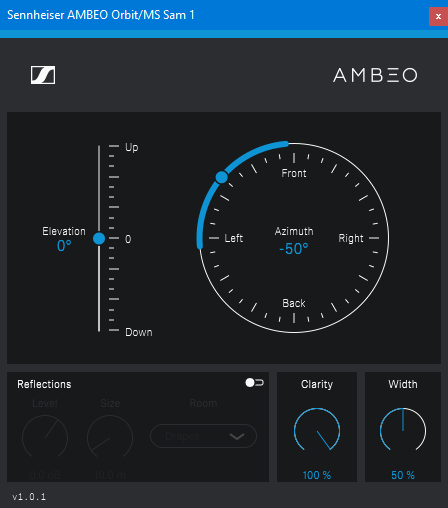

Most other effects were created by layering duplicates of sounds and de-tuning or pitch-shifting them to create more garbled, warped sounds, assisting to alienate the listener. In one instance, the voice sounded somewhat delayed; this was achieved by having some clips play a millisecond later than each other, creating a wider effect as the voice was panned in a 3-point circumference to envelope the listener.

Overall I feel like the amount of processing I used on the track was a fair amount, however it can be argued that space was available for other processes such as chorus, delay, reverb, further equalisation, and more; I admit that this would be a better approach, however due to the CPU meter spiking at times, leading to tracks cutting out if too many processes were active at once, I opted for a less VST-heavy alternative.
I think more mixing could have been achieved to balance out some aspects of the audio further, but I also believe that due to the piece being psychological and almost horror-esque in nature, sudden cuts and sharp sounds often benefit to keep the listener on edge, as this is not a peaceful soundscape piece.
If you wish to listen to 'The Terror' check out the Composition page in the Folio tab!
Comments